Pages

Showing posts with label non-fiction picture book. Show all posts

Wednesday, 14 August 2013

Sneak Peek: Big Red Kangaroo, by Claire Saxby and Graham Byrne

Peta Jinnath Andersen is an Online Consultant for Walker Books Australia. Her absolute, forever-and-ever favourite children's books are Guess How Much I Love You, A Bit Lost, Howl's Moving Castle, A Wrinkle in Time, A Monster Calls, and Winnie-the-Pooh. 

Kangaroos are a quintessential part of Australian life – they are emblematic, featured throughout official materials, shown on television shows, a fixture in many children’s songs. Depictions vary; often times, children see kangaroos as cute and cuddly or large and lazy. (As anyone who’s ever been to a kangaroo park at the zoo can attest.)

In Big Red Kangaroo, Claire Saxby and Graham Byrne have cast the kangaroo in a more natural light. Clear and beautiful prose details Big Red’s life; well-researched facts accompany the story, creating opportunities for discussion.

Far inland, where ocean is a dim memory, the sun floats on the waves of another bake-earth day. In the long shadows, a big red kangaroo licks his forearms and lets the early evening breeze wash over him.

Stunning illustrations of inland Australia bring depth to the story, and particularly to Big Red.


Both text and illustration highlight key non-fiction details and encourage readers to think about kangaroos and their place in the natural world. But, as with Flight of the Honeybee, this book is so much more than a story about kangaroos, or an exploration of facts. It's a pleasure to read aloud; it's exciting; it's full of opportunities for acting out what it is to be a kangaroo, or to go out into the world and consider how it would look to Big Red. It is a book that brings bush to city, and roos to heart.

Claire Saxby was born in Melbourne and grew up in Newcastle, NSW where she thought she'd stay until the end of her days. Then, while she was holidaying in Melbourne, Claire's parents decided to move to Bougainville Island in Papua New Guinea. Fortunately, they waited and took her with them. Since then, she's lived in more houses than she can remember. Claire is the author of Ebi's Boat, illustrated by Anne Spudvilas, which was a Children's Book Council of Australia Notable book in 2007. Her title published with Walker Books Australia in 2010, There Was an Old Sailor, illustrated by Cassandra Allen, was short-listed for the Speech Pathology Australia Book of the Year Awards 2010, Young Children Category. (See the colouring sheet here, or find the Classroom Notes.)

Born in Sydney sometime last century, Graham Byrne did the usual school and university time, worked as an electrical engineer for years, then went into building houses and structures. The old back injury put paid to hard physical work. An interest in art as a creative adjunct to the practical nature of building led to formal education, work installing artworks at the Museum of Contemporary Art in Sydney, and wonderings about other roads to explore. Wanting his art to have some 'practical' useful purpose, to be illuminating, pointed Graham to illustration and design pathways. Explorations of drawing, painting, filling sketchbooks, making books for his grandchildren and illustrating short stories have combined to prompt his journey as a book illustrator. Big Red Kangaroo is Graham’s first picture book.


Friday, 9 August 2013

Sneak Peek: Flight of the Honey Bee, by Raymond Huber and Brian Lovelock

Peta Jinnath Andersen is an Online Consultant for Walker Books Australia. Her absolute, forever-and-ever favourite children's books are Guess How Much I Love You, A Bit Lost, Howl's Moving Castle, A Wrinkle in Time, A Monster Calls, and Winnie-the-Pooh. 
 
The cold is coming and Scout is on a daring flight in search of the last flowers of autumn. Scout's mission is very dangerous, but it is also vital, because the flowers provide the precious nectar the hive needs to make honey. Can the hive make enough honey to survive the long winter months?

A new addition to our Nature Storybooks series, Flight of the Honey Bee details Scout’s journey to a meadow. Yet Scout’s story is far from prosaic; in fact, it’s rather poetic, and the dangers she faces are very real to a honey bee.

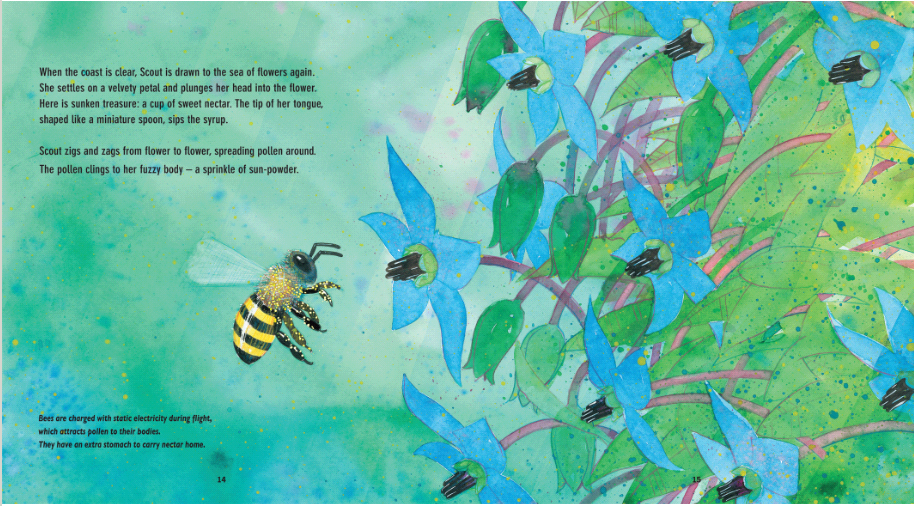
Scout zigs and zags from flower to flower, spreading pollen around. The pollen clings to her fuzzy body – a sprinkle of sun-powder.
As with all the Nature Storybooks, factual details provide a counterpoint and encourage deeper reading and discussion. At the end, there’s an author’s note, about honey bees, and their status as an endangered species. (There are also classroom notes available for Flight of the Honey Bee.)


But for me, the thing about this book isn’t just how very real Scout’s journey is, or even how it could encourage children and adults alike to learn more about colony collapse disorder and how we can save the bees. It’s that the story is very much a reflection of a child’s day, filled with almost timed phrases for how kindy and primary school kids journey through their own days. There’s leaving home for adventure (and knowing one will return home again); dealing with something difficult (and overcoming it); pausing for breath; telling everyone at home about one’s day; and reflecting (often with a parent) on the day, and how even the difficult parts were worth it.


It’s rare to find a book which is so inextricably tied to events children can relate to while at the same time presenting a story so unlike theirs. It’s something to glory in, that togetherness – and the facts alongside provide a rather lovely set of grace notes. (The illustrations, too, are truly gorgeous. The first one, where “a bee the size of a cherry pip”, sets out, is my favourite.)

Learn more about Nature Storybooks: Flight of the Honey Bee here or learn more about honey bees with our classroom notes.

Raymond Huber lives in Dunedin. He has been a social worker, gardener, primary school teacher, lecturer, and is currently a writer and editor. He's written Science and English textbooks and short stories for children. Sting, his first novel for Walker Books Australia, was short-listed for the NZ Post Book Awards for Children & Young Adults, Junior Fiction Category, 2010; and the Sir Julius Vogel Awards, Young Adult Category, 2010; as well as being a Storylines Notable Book, Junior Fiction Category, 2010. (Read more of Ziggy's adventures in the sequel, Wings.)

Brian Lovelock is a scientist working in the power industry in New Zealand. He has painted all his life but has only recently ventured into the world of book illustration. His previous titles with Walker Books Australia include Did My Mother Do That! and Roadworks, which won the Picture Book category in the 2009 New Zealand Post Book Awards for Children & Young Adults. Brian was recently long-listed for the CILIP Kate Greenaway Award for his work on Demolition.

Wednesday, 3 July 2013

Sneak Peek: A Little Election

A Little Election, Danny Katz and Mitch Vane

The federal election is almost here - and along with it, a reissue of Danny Katz and Mitch Vane's A Little Election. It's a lovely introduction to politics for children five and up.

One day at lunchtime, Rory decides to become the Prime Minister because then he can do anything he wants. Which then leads to class election...


A Little Election, Danny Katz and Mitch Vane, spread 1
But can you become the Prime Minister if you show everyone your undies?

Danny Katz is a newspaper columnist for The Age and the Sydney Morning Herald, and is famous for his larger-than-life characters.


A Little Election, Danny Katz and Mitch Vane, spread 2 Mitch Vane has illustrated many children's books, including the Little Lunch series, A Little Election and The Patch. She hates to draw straight lines!

Read more about A Little Election here.


Wednesday, 27 March 2013

Celebrate Easter with a Bilby!


Peta Jinnath Andersen is an Online Consultant for Walker Books Australia. Her absolute, forever-and-ever favourite children's books are Guess How Much I Love You, A Bit Lost, Howl's Moving Castle, A Wrinkle in Time, A Monster Calls, and Winnie-the-Pooh. 

With Easter fast approaching, our thoughts are rapidly turning to chocolate - chocolate eggs, chocolate bunnies, and, of course, chocolate bilbies! They've been associated with Easter in Australia for a long time, though their popularity really began in the nineties.

For those of us who want a little less sugar this Easter, bilbies are still a lovely way to celebrate.


In Bilby Secrets, one of the books in our non-fiction Nature Storybooks series, author Edel Wignell and illustrator Mark Jackson explore the journey a bilby takes from birth through adulthood. It's a marvellous example of a non-fiction picture book which teaches through story.

A beautiful narrative non-fiction book which follows the life of a bilby, an Australian marsupial. The story depicts a young bilby's birth, habitat, behaviour and diet. When Baby Bilby is born, he's as long as your little toe. He crawls into his mother's warm pouch, where he feeds and grows. Baby Bilby is soon ready to leave the safety of the burrow. He follows his mother closely, sniffs the night air, and hops into the moonlight for his first desert adventure.

Rather than providing readers with a textbook-like list of dry facts, Bilby Secrets introduces a bilby's habits and survival secrets through story; a short factual explanation of why Baby Bilby behaves as he does adds depth to the story, in the same way understanding character motivations add depth to a novel. And facts are presented in easy to relate to ways - "When Baby Bilby is born, he's as long as your little toe".  Whenever I read that line to my son, he looks at his little toe in wonder, trying to imagine a baby that small. Illustrations enhance the story, while also adding a layer of factual detail - what a bilby burrow looks like, the sort of environment a bilby lives in, and more.


One of the things I love about Bilby Secrets and narrative non-fiction picture books in general is how they open up a world of discussion - the fact that a baby bilby is the size of a little toe easily segues to a chat about the size of other baby animals. Are baby kangaroos that small? Are piglets that small? (Yes and no respectively; marsupial babies are little-toe size while placental or eutherian babies are not.) And that discussion leads to another, about marsupials, which may lead to another about mammals and so on and so forth. It's a kind of guided learning, without pressure, that's suited to children of all ages - even one year olds can explore the idea of a bilby with a book such as this, especially when cuddled up with a loved one.

Looking for more narrative non-fiction? Take a look at the rest of our Nature Storybook series, and keep an eye out for Big Red Kangaroo, out later this year.


Credits: Text © 2011 Edel Wignell, Illustrations © 2011 Mark Jackson. All rights reserved.